
I have worked with a lot of educators over the years. Some were great teachers. Some were great leaders. But not all of them were both. That is when I started looking into a master’s degree in educational leadership. And I realized something important.
Great teachers do not always make great leaders. Leading a school requires a different set of skills. It is about vision, strategy, and building capacity in others. It is about navigating complex challenges while staying true to the values of education.
What Is a Master’s Degree in Educational Leadership?
Here is the honest truth. A master’s degree in educational leadership is not just another academic qualification. It is a program designed to prepare educators for leadership roles in schools and educational institutions.
The program focuses on developing leaders who can foster innovation and drive educational change . It is especially relevant in rapidly developing regions like the UAE, where education is valued as a foundation for growth .
Subjects typically include curriculum design, organizational theory, and ethical decision-making . Students engage in collaborative projects and develop strategic planning skills vital for effective leadership . The curriculum often emphasizes research, allowing you to address real-world challenges through evidence-based practices .
The role of educational leaders is to build capacity and positive teams of educators while sharing leadership and nurturing the development of these teams and individuals . In Dubai alone, according to the KHDA, there are over 200 private schools, around 21,000 teachers, teaching across several curricula to a community of around 295,000 students of 170 nationalities .
Let me share what I learned. And why I think a master’s degree in educational leadership is something every aspiring school leader should consider. And if you are looking for expert help with your digital strategy, you might want to check out our SEO services to get professional support for your business.
Why Educational Leadership Matters
The learning environment is undergoing rapid changes reflecting broader transformations across the world . According to the World Economic Forum, education models must adapt to equip children with the skills to create a more inclusive, cohesive, and productive world .
All educators have a powerful influence in guiding the learning and development of children and young adults in the community . Educational leaders must face the challenges of globalizing education and the increasing realities of financial pressures, resource constraints, and the rising expectations of stakeholders .
A good educational leadership program is designed to empower leaders to balance these challenges with the core fundamental values of education, with competency and compassion .
Leadership and Management: What is the Difference?
While researching, I also explored the relationship between leadership and management. Understanding the difference between leadership and management helps put educational leadership in context.
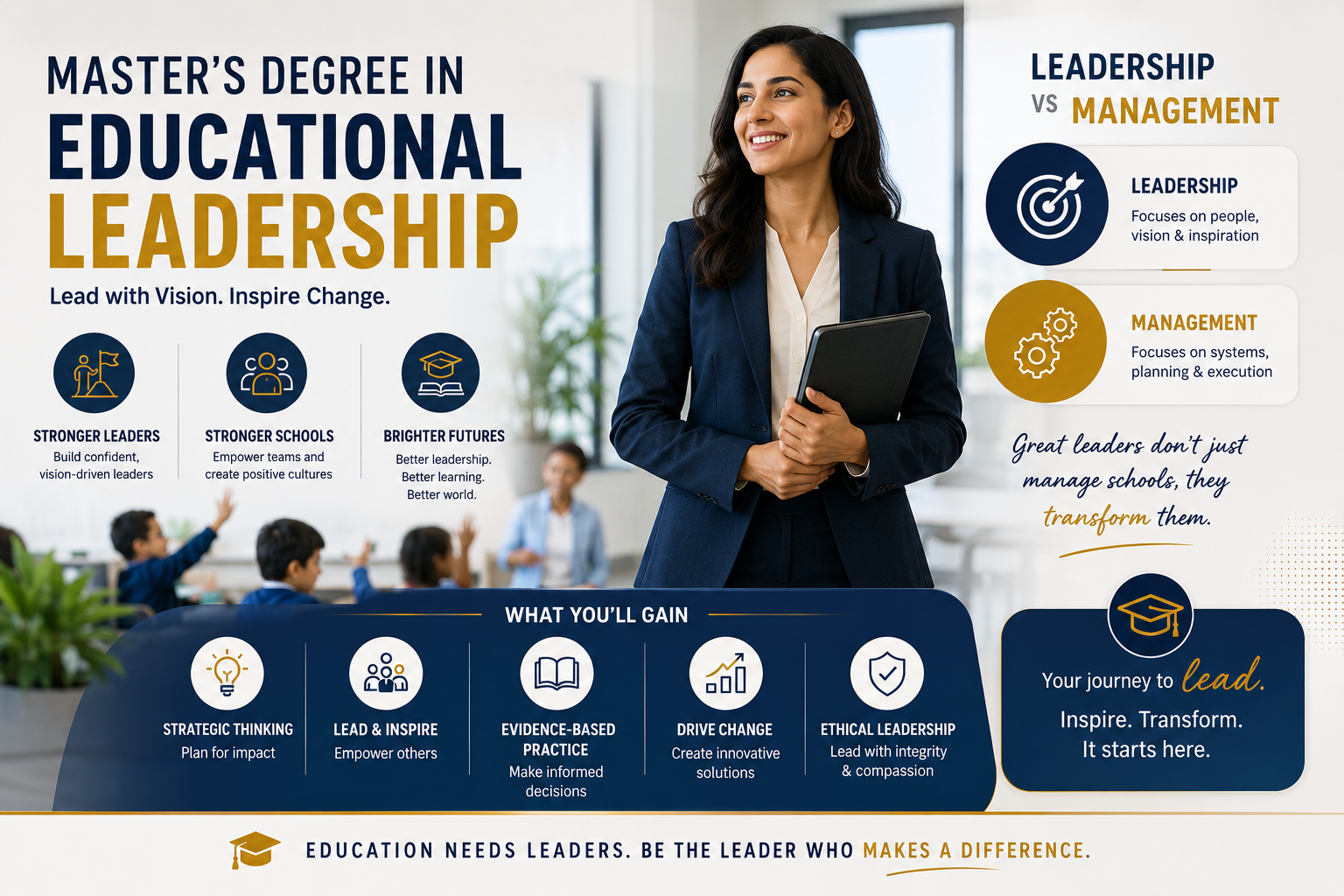
Leadership focuses on vision, purpose, and influence. Leaders inspire people to move forward and create a common future. They ask “what” and “why” .
Management focuses on planning, coordination, and execution. Managers ensure a job gets done efficiently and effectively. They ask “how” and “when” .
A simple way to distinguish between the two is that we lead people and manage things . Managing people implies control, but leadership is more about influencing, developing, coaching, guiding, or mentoring people .
Leaders are more concerned with the vision and where the organization is heading. They view motivation and inspiration as their main responsibilities . Managers see it as their responsibility to get the job done as efficiently and effectively as possible .
In high-performing organizations, leadership and management are not opposing roles but a continuum of a single construct . Effective professionals in modern organizations have to be both. Knowing when to lead change and knowing when to manage execution is critical to sustained performance .
A Real Example From My Research
A friend of mine is a teacher in Dubai. She was passionate about education but felt frustrated by the limitations of her role. She wanted to make a bigger impact but did not know how.
She decided to pursue a master’s degree in educational leadership. The program helped her develop new skills and a broader perspective. She learned how to lead teams, manage change, and create a positive school culture.
Within two years of graduating, she became a head of department and is now being mentored for a principal role. She told me that the degree gave her the confidence and credibility to pursue leadership opportunities.
That is the power of educational leadership.
So Should You Pursue a Master’s Degree in Educational Leadership?
If you are an educator who wants to make a bigger impact, the answer is yes.
A master’s degree in educational leadership opens doors to new career opportunities. It helps you develop the skills to lead schools and shape educational policy. It prepares you to face the challenges of modern education.
Whether you are a teacher, department head, or aspiring principal, this degree can help you grow as a leader. In the UAE, where the education sector is growing rapidly, there are many opportunities for qualified leaders .
Just remember, leadership is about more than just a title. It is about making a difference in the lives of students and teachers.
Have you considered a master’s degree in educational leadership? Or are you still thinking about it? I would love to hear about your experience.