
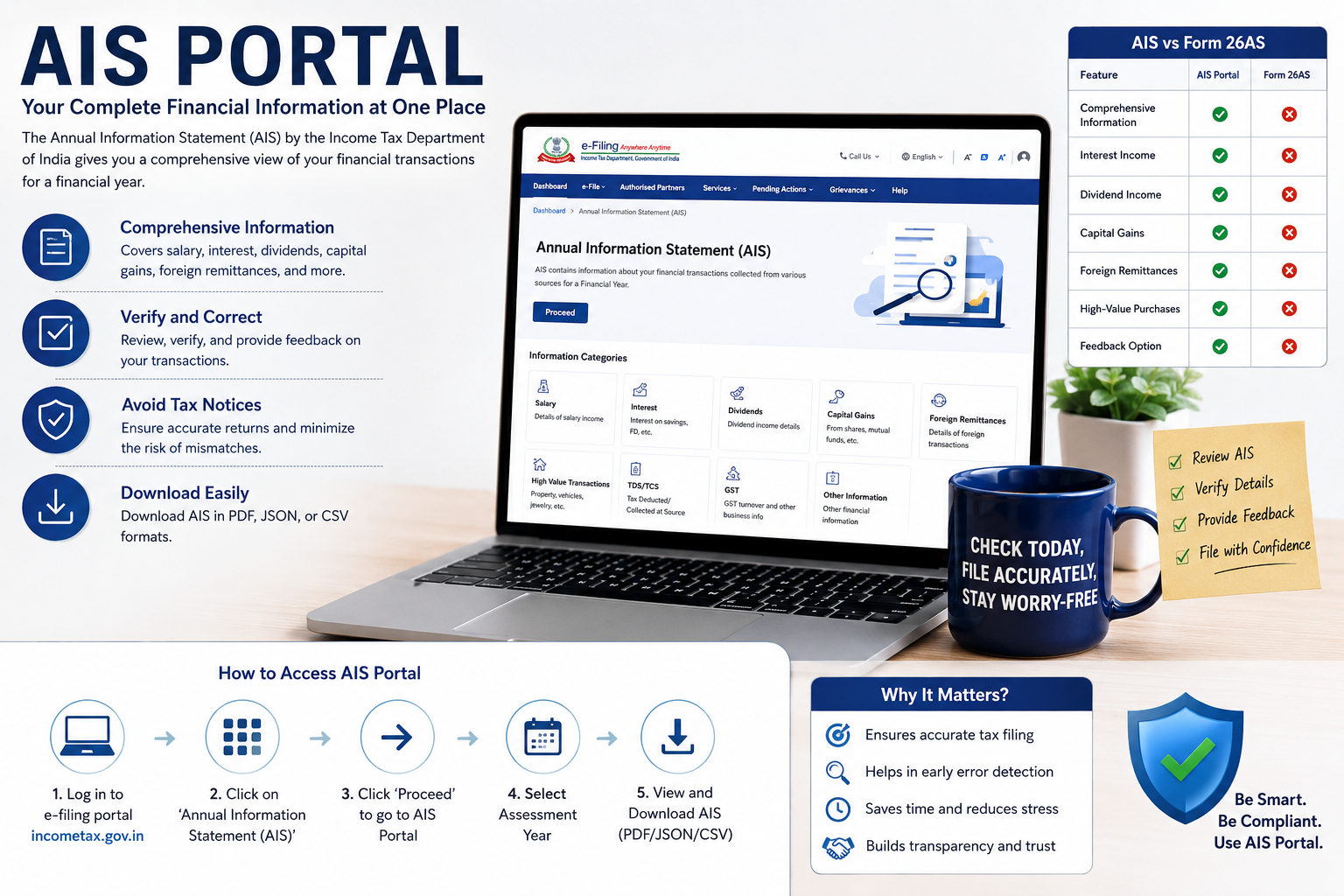
I have filed my taxes for years. And every year, I worried about missing something. A missed interest payment. An unreported dividend. Some transaction I forgot about. But the AIS portal changed that for me. It made tax filing less stressful and more transparent. The Annual Information Statement (AIS) is a tool introduced by the Income Tax Department of India to help taxpayers file accurate returns.
It is an extended version of Form 26AS and gives a comprehensive view of your financial information. And if you are building a website for your business or tax practice, you might want to check out our web design and development services first so you have a solid foundation.
What Is the AIS Portal?
The AIS portal is a compliance platform that provides taxpayers with a complete picture of their financial transactions for a financial year. Unlike the older Form 26AS, which mainly showed TDS and TCS, the AIS portal covers much more.
It displays income from salaries, interest, dividends, mutual fund and stock transactions, foreign remittances, and high-value purchases. It also shows you both the reported value (what the system shows) and the modified value (after you provide feedback).
This level of detail helps you catch errors before you file. You can review, verify, and correct any discrepancies. That is a big deal when you think about avoiding tax notices.
The portal also provides a Taxpayer Information Summary (TIS). This is a summarized view of your financial information that helps with pre-filling your return. It makes the filing process smoother and reduces the chance of mistakes.
How to Access the AIS Portal
The AIS portal is accessible through the Income Tax Department’s e-filing website. Here is how you can access it.
-
Log in to the e-filing portal at
incometax.gov.inusing your PAN or Aadhaar and password. -
On the dashboard, click the “Annual Information Statement (AIS)” menu option.
-
Click “Proceed” to be redirected to the AIS portal.
-
You can also access it by going to the e-File menu, selecting Income Tax Return, and then clicking View AIS.
Once you are on the AIS portal, you can view your statement and download it in PDF, JSON, or CSV formats. The PDF is password-protected using your PAN in lowercase and your date of birth in DDMMYYYY format.
The portal also allows you to toggle between different assessment years. That is useful if you need to review previous years’ statements or compare data across years.
Why Checking Your AIS Matters
I learned the hard way that skipping AIS verification can cause problems. One friend of mine filed his return without checking his AIS. He missed a small interest payment from a fixed deposit. A few months later, he got a notice from the tax department. That is not a fun experience.
Checking the AIS portal before filing helps you avoid that. It ensures your return is accurate and minimizes the risk of mismatches. If you find a discrepancy, you can provide feedback. The portal allows you to report errors or mark transactions as correct, partially correct, or not related to you.
This feedback process is important because it updates the Taxpayer Information Summary (TIS), which is used for pre-filling your return.
The feedback you provide on the AIS portal is also visible to the tax department. This helps them improve data quality and reduce errors in reporting. So your feedback not only helps you but also helps other taxpayers.
What Information Does the AIS Portal Show?
The AIS portal provides a wide range of information. Here is what you can expect to see.
-
Income from salary and pensions.
-
Income from interest on deposits and savings accounts.
-
Dividends from shares and mutual funds.
-
Capital gains from stock and mutual fund transactions.
-
Foreign remittances and income from overseas sources.
-
High-value purchases like property, vehicles, or jewelry.
-
Tax deducted at source (TDS) and tax collected at source (TCS).
-
GST turnover and other business-related information.
This comprehensive view helps you identify all your income sources. You might even discover income you forgot about, like I did.
Common Issues and What to Do
Like any government portal, the AIS portal can sometimes be slow, especially during peak filing seasons. For example, around the September 2025 ITR deadline, the portal experienced heavy traffic. It saw over 41.6 lakh logins and nearly 16.8 crore hits on a single day. That volume caused delays and access problems for some users.
If you face similar issues, here are a few things you can try.
-
Use updated browsers like Google Chrome, Microsoft Edge, or Mozilla Firefox.
-
Clear your browser cache and cookies.
-
Try logging in during off-peak hours like early morning or late evening.
-
Use a wired internet connection for better stability.
If you are a tax professional, you might have used third-party software to download AIS data. The tax department has restricted this to prevent system overload. Now, you need to log in to each client’s account to download their AIS manually. This takes more time, but it helps maintain system integrity.
Another common issue is incorrect or duplicate entries. Sometimes, a transaction might appear twice or with the wrong amount. In such cases, you can provide feedback on the AIS portal to correct the information.
A Real Example From My Experience
I used the AIS portal for the first time last year. I logged in, navigated to the AIS menu, and was redirected to the compliance portal. I selected my assessment year and viewed the AIS. It showed a transaction I had completely forgotten about. A small dividend from some shares I bought years ago. I did not remember it. But the AIS portal did.
I reviewed the entry, confirmed it was correct, and included it in my return. That single check likely saved me from a notice. It took me less than 10 minutes. That is time well spent.
I also noticed an entry that did not belong to me. It was a fixed deposit interest from a bank I had never used. I marked it as “not related to me.” The portal accepted my feedback and updated the TIS accordingly. That was a relief.
How the AIS Portal Compares to Form 26AS
Here is a quick comparison between the AIS portal and Form 26AS.
AIS Portal:
-
Information covered: Comprehensive
-
TDS/TCS details: Yes
-
Interest income: Yes
-
Dividend income: Yes
-
Capital gains: Yes
-
Foreign remittances: Yes
-
High-value purchases: Yes
-
Feedback option: Yes
Form 26AS:
-
Information covered: Limited
-
TDS/TCS details: Yes
-
Interest income: No
-
Dividend income: No
-
Capital gains: No
-
Foreign remittances: No
-
High-value purchases: No
-
Feedback option: No
As you can see, the AIS portal is a significant upgrade. It provides much more information and allows you to correct errors. If you are still relying only on Form 26AS, you are missing out.
Technology Companies in Dubai and the AIS Portal
While the AIS portal is specific to India, the underlying technology is similar to what technology companies in Dubai use for financial compliance platforms. The portal uses secure authentication, real-time data processing, and cloud infrastructure.
If you are in Dubai, you might find that Dubai technologies like local cloud providers or fintech platforms offer similar solutions for financial reporting. In fact, the UAE is investing heavily in digital government services. The lessons from India’s AIS portal could be useful for companies building similar platforms in the region.
For example, the use of PAN-based authentication, encrypted PDFs, and structured data formats like JSON and CSV are standard practices. These are areas where technology companies in Dubai can learn and innovate.
So Should You Use the AIS Portal?
If you are an Indian taxpayer, using the AIS portal is not optional. It is essential. It helps you file accurate returns, avoid notices, and stay compliant.
The portal is straightforward. You log in, view your statement, verify the details, and flag any errors. The whole process takes just a few minutes.
Just remember to plan ahead. Do not wait until the last day. The portal gets busy. Access it early and avoid the rush.
I also recommend downloading your AIS as soon as it becomes available. That gives you enough time to review and provide feedback if needed.
Have you used the AIS portal yet? Or are you still relying only on Form 26AS? I would love to hear about your experience.